Publications
Climate Inequality: Carbon Capture for Redistribution
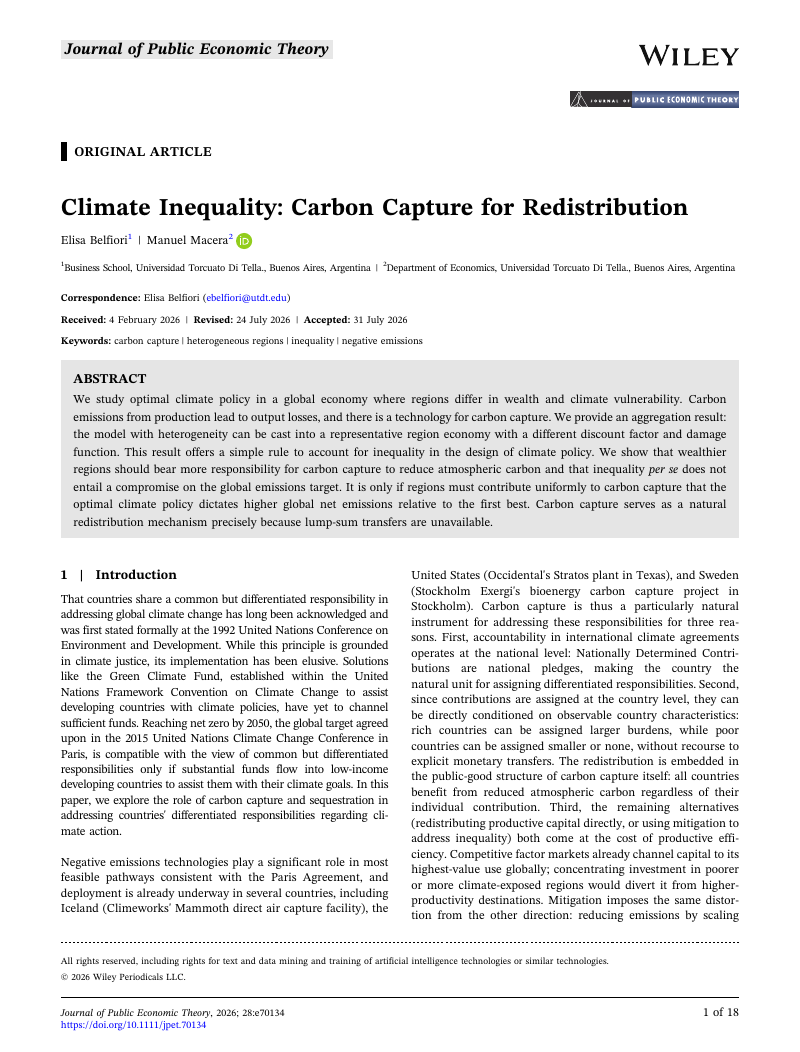
We study optimal climate policy in a global economy where regions differ in wealth and climate vulnerability. We provide an aggregation result: the model with heterogeneity can be cast into a representative-region economy with a different discount factor and damage function, giving a simple rule for accounting for inequality in climate policy design. Wealthier regions should bear more responsibility for carbon capture, and inequality per se does not require compromising the global emissions target. Carbon capture serves as a natural redistribution mechanism precisely because lump-sum transfers are unavailable.
Optimal Climate Policy with Demographic Transitions
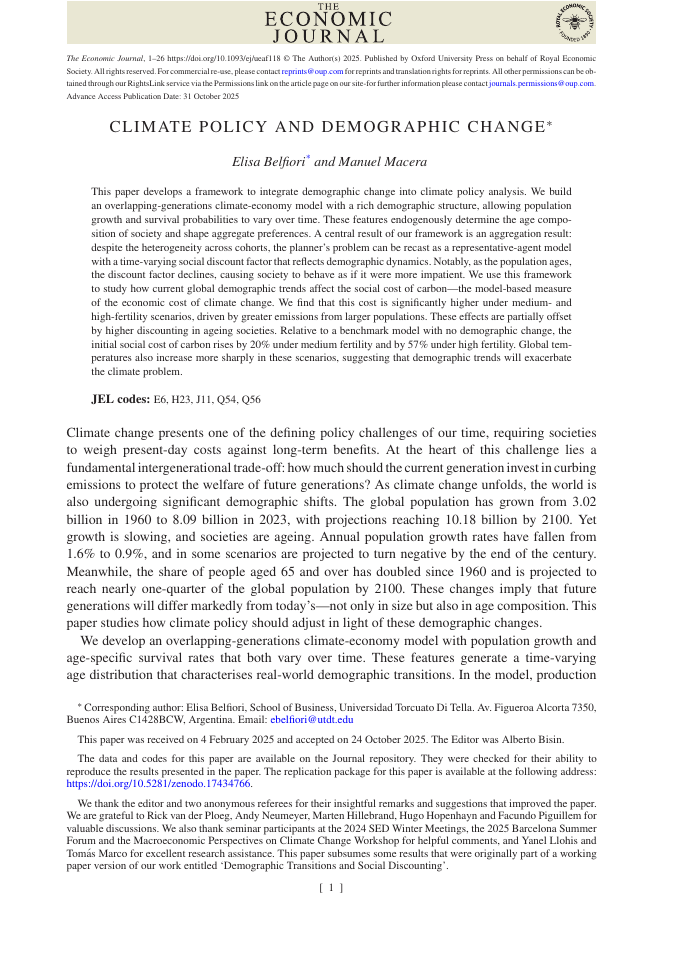
We build an overlapping-generations climate-economy model with a rich demographic structure, allowing population growth and survival probabilities to vary over time. The planner's problem can be recast as a representative-agent model with a time-varying social discount factor that reflects demographic dynamics — as the population ages, society behaves as if more impatient. The social cost of carbon rises significantly under medium- and high-fertility scenarios, driven by larger populations, partially offset by higher discounting in ageing societies.
Demographic Changes and Social Discounting
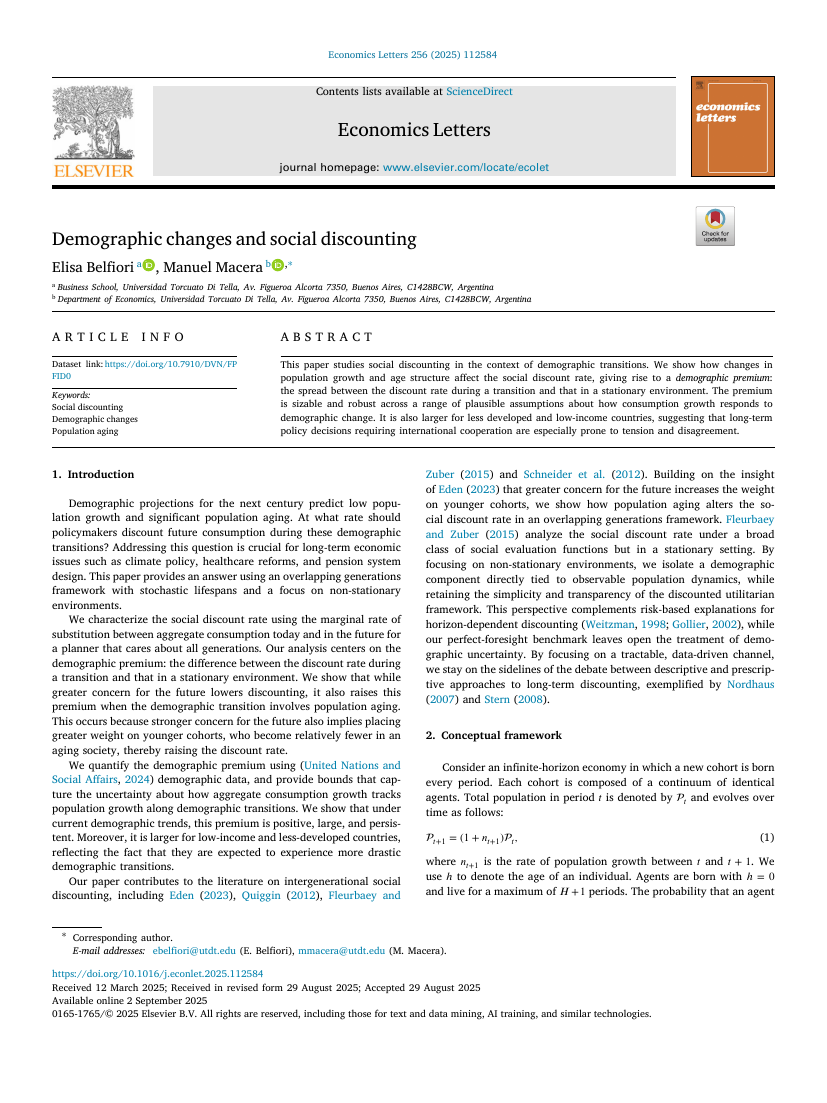
We study social discounting under demographic transitions, showing how changes in population growth and age structure give rise to a "demographic premium" — the spread between the discount rate during a transition and in a stationary environment. The premium is sizable and larger for less developed, low-income countries, suggesting long-term policy decisions requiring international cooperation are especially prone to disagreement.
Inequality and Technological Change
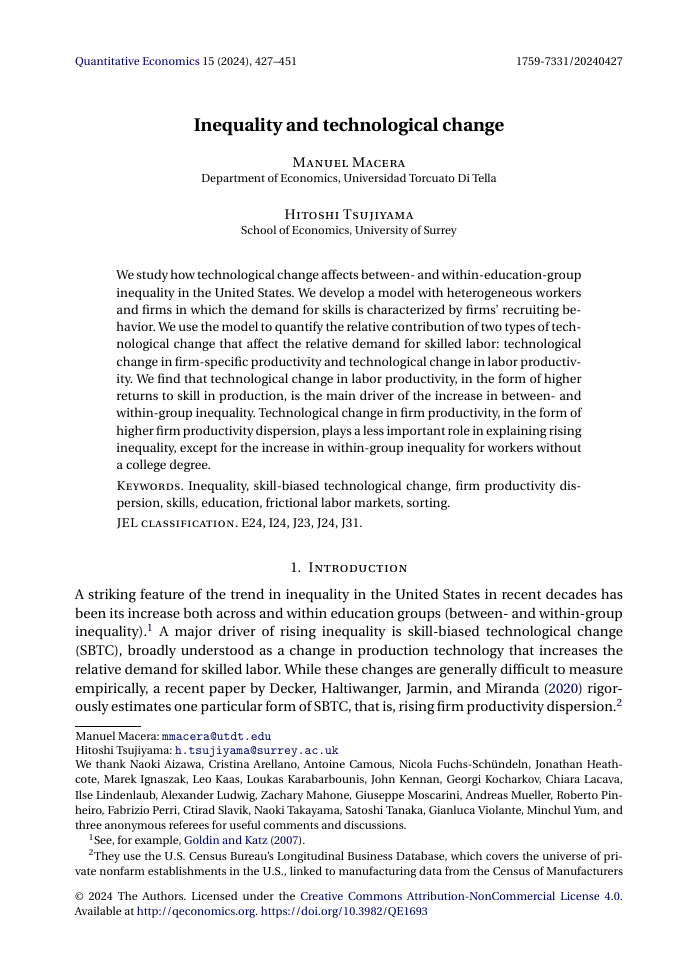
We study how technological change affects between- and within-education-group inequality in the United States, using a model with heterogeneous workers and firms in which the demand for skills is characterized by firms' recruiting behavior. We find that technological change in labor productivity — higher returns to skill — is the main driver of rising inequality, while higher firm productivity dispersion plays a smaller role.
Covid-19 in Unequal Societies
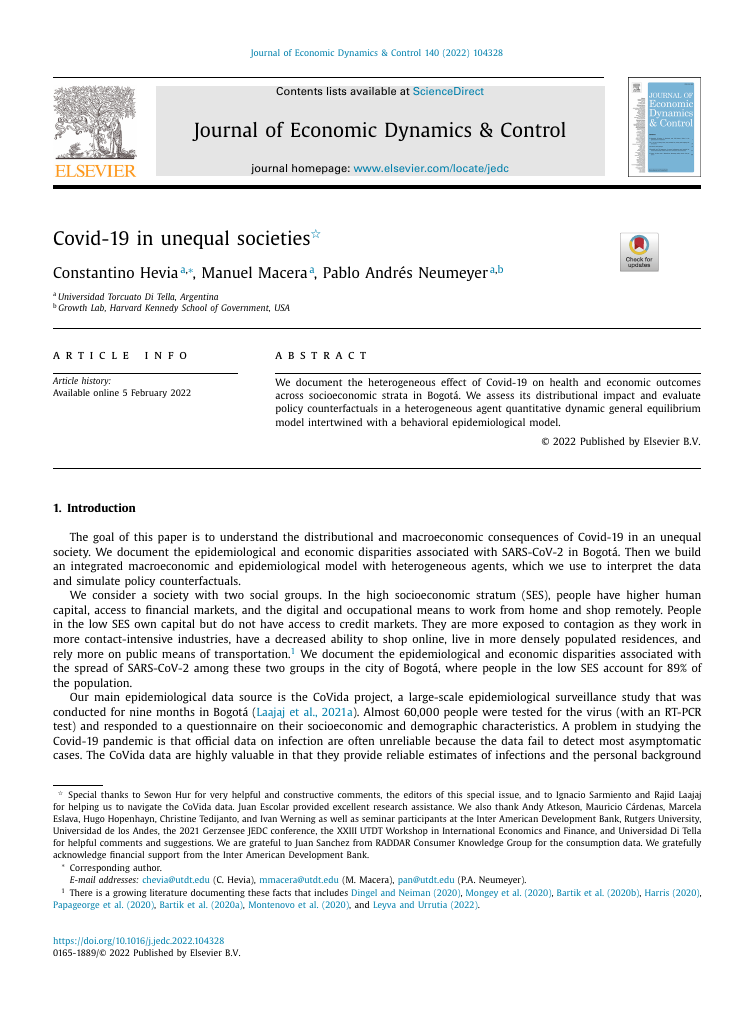
We document the heterogeneous effect of covid-19 on health and economic outcomes across socioeconomic strata in Bogotá. We assess its distributional impact and evaluate policy counterfactuals in a heterogeneous-agent quantitative dynamic general equilibrium model intertwined with a behavioral epidemiological model.
Working Papers
Policy during Hyperinflations
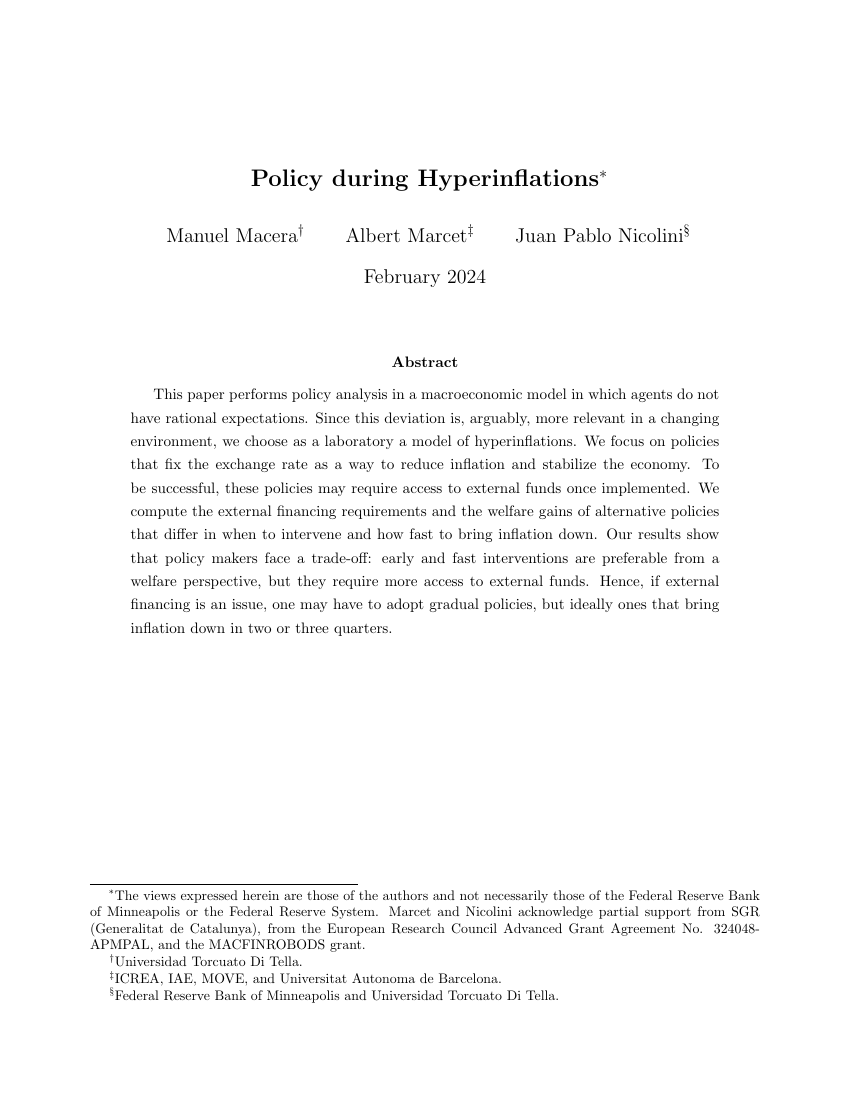
We perform policy analysis in a macroeconomic model in which agents do not have rational expectations, using hyperinflation episodes as a laboratory. We focus on policies that fix the exchange rate to reduce inflation and stabilize the economy, computing the external financing requirements and welfare gains of alternative policies. Early and fast interventions are preferable on welfare grounds but require more access to external funds.
Demographic Transitions and Fiscal Imbalances in Latin America
PDF temporarily unavailable — source file needs to be re-uploaded.
On the Risk of Leaving the Euro

Following the sovereign debt crisis of 2012, some southern European countries debated proposals to leave the Euro. We evaluate this policy change in a standard monetary model with seigniorage financing of the deficit, departing from rational expectations while maintaining full rationality of agents. Small departures from rational expectations imply that inflation upon exit can be orders of magnitude higher than under rational expectations.
Credit Crises and Private Deleveraging
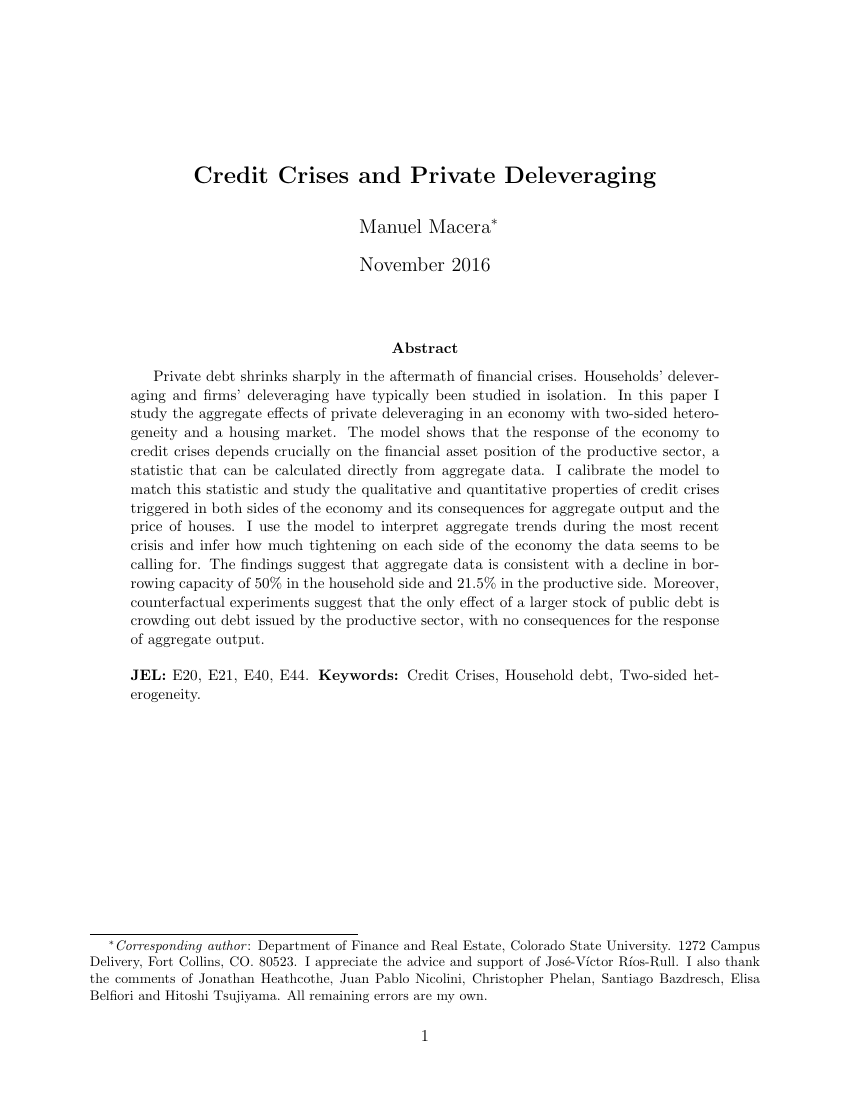
Private debt shrinks sharply after financial crises, but households' and firms' deleveraging have typically been studied in isolation. I study the aggregate effects of private deleveraging in an economy with two-sided heterogeneity and a housing market, showing the response of the economy to credit crises depends crucially on the financial asset position of the productive sector — a statistic calculable directly from aggregate data.
Work in Progress
- Irreversible Investment and Market Sentiment — with Christian Krestel
- Precautionary Behavior and Aggregate Savings